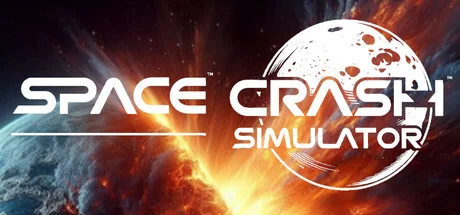
Space Crash Simulator
WPC
Real-time planetary collision sandbox powered by SPH physics: smash planets together and watch the destruction and its aftermath!
Системные требования
Минимальные требования
Рекомендуемые требования
Об этой игре
Space Crash Simulator is a real-time planetary collision sandbox powered by GPU-accelerated SPH (Smoothed Particle Hydrodynamics). Every planet, star, and fragment is built from interacting particles that deform, melt, and break apart under extreme forces.
The simulator is designed as an open-ended tool rather than a traditional game. There are no missions or objectives. You set the initial conditions, run the simulation, and observe the results.
You can control key physical parameters such as:
particle count
particle mass
viscosity
impact velocity
spin and angular momentum
Planets can be customized with built-in textures or user-imported images. A high-mass “black hole particle” is also available for experiments involving tidal disruption and extreme gravity.
Simulation Modes
Two-Body Collisions
Direct or glancing impacts between two celestial bodies.
Three-Body Interactions
Unpredictable gravitational dynamics where small differences in initial conditions produce very different outcomes.
Protoplanetary Disc + Star
Experiments involving accretion, disc formation, and early system evolution.
Galaxy Mode
Simplified large-scale interactions between galactic cores. This mode focuses on gravitational dynamics and does not apply full SPH fluid simulation due to scale.
Physics Approach
Space Crash Simulator uses Smoothed Particle Hydrodynamics to model high-energy impacts and material flow. This method is commonly used in scientific simulation of fluids, pressure, and deformation. As a result, bodies behave like cohesive matter under stress rather than rigid objects. Fragmentation, shock fronts, stretching, and accretion emerge naturally from the underlying equations.
Intended Use
The simulator is suited for players interested in:
astrophysics
orbital mechanics
impact dynamics
scientific visualization
open-ended sandbox experimentation
It is not a mission-based game and does not include a storyline, progression system, or competitive mechanics. The focus is entirely on constructing scenarios, adjusting parameters, and observing the physical behaviour that follows.
Поделитесь своим игровым опытом
Help other gamers! Share how this game runs on your setup, share tips, or ask questions.
Лучшие игры
Discover similar games you might enjoy based on genre and creator.

Отказ от ответственности
Информация об игре, изображения, описания и системные требования, представленные на этой странице, получены со сторонних платформ и не принадлежат Can I Run It. Мы не связаны с разработчиками, издателями или дистрибьюторами игр, не поддерживаемся ими и не имеем к ним отношения.
Can I Run It — это сервис проверки совместимости системы, который помогает пользователям определить, может ли их оборудование запускать определенные игры. Мы не продаем, не распространяем и не размещаем игровой контент.
Все товарные знаки, зарегистрированные товарные знаки, названия продуктов и названия компаний или логотипы, упомянутые здесь, являются собственностью их соответствующих владельцев.
Если вы считаете, что какой-либо отображаемый контент нарушает ваши права интеллектуальной собственности, свяжитесь с нами по адресу [email protected] с соответствующими подробностями, и мы оперативно рассмотрим ваши вопросы.