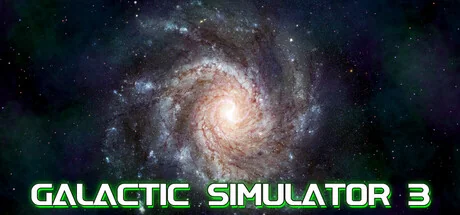
Galactic Simulator 3
PcZ Games
Galactic Simulator 3 is a space exploration and evolution sim inspired by the Fermi Paradox and Great Filter theory. Scan uncharted star systems, gather resources and samples, establish outposts and stargates, and witness the rise and fall of civilizations across an ever-evolving galaxy.
Системные требования
Минимальные требования
Рекомендуемые требования
Об этой игре
Fermi Paradox
“Where are they?”
To date, we have found no reliable evidence that extraterrestrial civilizations have visited Earth. With countless stars and planets throughout the galaxy, why does intelligent life appear to be so rare?
Humanity has survived its own journey through the Great Filter and become an interstellar civilization. Now it is time to leave the Solar System and search for civilizations that may—or may not—have completed the same journey.
Drake Equation
N = R* × Fp × Ne × Fl × Fi × Fc × L
N: The number of detectable extraterrestrial civilizations in the galaxy
R*: The rate of star formation in the galaxy
Fp: The fraction of stars with planetary systems
Ne: The number of potentially habitable planets per planetary system
Fl: The fraction of suitable planets on which life emerges
Fi: The fraction of life-bearing planets on which intelligent life emerges
Fc: The probability that a civilization emits detectable signals
L: The length of time such a civilization remains detectable
The Drake Equation attempts to estimate how many detectable extraterrestrial civilizations might exist in the galaxy.
The Great Filter
The Great Filter is the theory that one or more extraordinarily difficult barriers exist between the earliest stages of chemical evolution and a civilization capable of reaching the stars. These barriers may explain why detectable extraterrestrial life appears to be so rare.
In the game, a Great Filter can halt, reverse, or completely end a world’s evolutionary journey.
Asteroid impacts, extreme radiation, ice ages, greenhouse effects, ecosystem collapse, supervolcanic eruptions, global pandemics, nuclear disasters, resource exhaustion, war, uncontrolled artificial intelligence, and cosmic catastrophes can erase billions of years of progress.
Some planets will remain silent forever. Some will harbor only simple life. A rare few may develop civilizations capable of reaching the stars.
An Ever-Evolving Galaxy
Compared with previous entries, the scale of the simulation has expanded dramatically, bringing tens of thousands of stars together within a far more expansive galaxy.
Cosmic time continues to advance as you explore. Discovered planets may progress through thirteen evolutionary stages:
Inorganic Matter
Organic Molecules
Self-Replicating Molecules
Prokaryotic Cells
Eukaryotic Cells
Multicellular Organisms
Intelligent Organisms
Tribal Society
Agricultural Society
Industrial Civilization
Planetary Civilization
Interplanetary Civilization
Interstellar Civilization
A planet’s physical conditions and evolutionary potential determine how far life may develop. Yet even the most promising world is never guaranteed to overcome every obstacle.
Survey the Unknown
Every expedition gives you a limited number of scans and interstellar jumps.
Navigate the routes between stars, decide which systems are worth investigating, bookmark promising targets, and search for signals of valuable resources or advanced life. Manage your survey probes and starship fuel carefully, and plan your route before the expedition can go no farther.
Venture Among the Stars
Enter scanned systems, pilot your ship between stellar and planetary orbits, and inspect celestial bodies at close range. Each star and planet has its own appearance and a collection of physically inspired properties.
Survey these celestial bodies to recover minerals, organic matter, biological samples, and research data documenting intelligent life.
From Discovery to Expansion
Enable automatic exploration to let your ship jump, scan, and investigate star systems on its own, keeping the expedition moving without constant input.
Build outposts in remote systems and use stargates to discover new sectors, pushing the frontier ever deeper into the galaxy.
How many civilizations will you discover—and how many will vanish before you arrive?
Поделитесь своим игровым опытом
Help other gamers! Share how this game runs on your setup, share tips, or ask questions.
Лучшие игры
Discover similar games you might enjoy based on genre and creator.





Отказ от ответственности
Информация об игре, изображения, описания и системные требования, представленные на этой странице, получены со сторонних платформ и не принадлежат Can I Run It. Мы не связаны с разработчиками, издателями или дистрибьюторами игр, не поддерживаемся ими и не имеем к ним отношения.
Can I Run It — это сервис проверки совместимости системы, который помогает пользователям определить, может ли их оборудование запускать определенные игры. Мы не продаем, не распространяем и не размещаем игровой контент.
Все товарные знаки, зарегистрированные товарные знаки, названия продуктов и названия компаний или логотипы, упомянутые здесь, являются собственностью их соответствующих владельцев.
Если вы считаете, что какой-либо отображаемый контент нарушает ваши права интеллектуальной собственности, свяжитесь с нами по адресу [email protected] с соответствующими подробностями, и мы оперативно рассмотрим ваши вопросы.