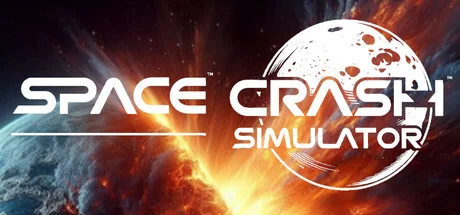
Space Crash Simulator
WPC
Real-time planetary collision sandbox powered by SPH physics: smash planets together and watch the destruction and its aftermath!
Requisiti di sistema
Requisiti minimi
Requisiti raccomandati
Informazioni su questo gioco
Space Crash Simulator is a real-time planetary collision sandbox powered by GPU-accelerated SPH (Smoothed Particle Hydrodynamics). Every planet, star, and fragment is built from interacting particles that deform, melt, and break apart under extreme forces.
The simulator is designed as an open-ended tool rather than a traditional game. There are no missions or objectives. You set the initial conditions, run the simulation, and observe the results.
You can control key physical parameters such as:
particle count
particle mass
viscosity
impact velocity
spin and angular momentum
Planets can be customized with built-in textures or user-imported images. A high-mass “black hole particle” is also available for experiments involving tidal disruption and extreme gravity.
Simulation Modes
Two-Body Collisions
Direct or glancing impacts between two celestial bodies.
Three-Body Interactions
Unpredictable gravitational dynamics where small differences in initial conditions produce very different outcomes.
Protoplanetary Disc + Star
Experiments involving accretion, disc formation, and early system evolution.
Galaxy Mode
Simplified large-scale interactions between galactic cores. This mode focuses on gravitational dynamics and does not apply full SPH fluid simulation due to scale.
Physics Approach
Space Crash Simulator uses Smoothed Particle Hydrodynamics to model high-energy impacts and material flow. This method is commonly used in scientific simulation of fluids, pressure, and deformation. As a result, bodies behave like cohesive matter under stress rather than rigid objects. Fragmentation, shock fronts, stretching, and accretion emerge naturally from the underlying equations.
Intended Use
The simulator is suited for players interested in:
astrophysics
orbital mechanics
impact dynamics
scientific visualization
open-ended sandbox experimentation
It is not a mission-based game and does not include a storyline, progression system, or competitive mechanics. The focus is entirely on constructing scenarios, adjusting parameters, and observing the physical behaviour that follows.
Condividi la tua esperienza di gioco
Help other gamers! Share how this game runs on your setup, share tips, or ask questions.
Giochi più votati
Discover similar games you might enjoy based on genre and creator.

Avvertenza legale
Le informazioni sul gioco, le immagini, le descrizioni e i requisiti di sistema visualizzati su questa pagina provengono da piattaforme di terze parti e non sono di proprietà di Can I Run It. Non siamo affiliati, approvati o collegati agli sviluppatori, editori o distributori del gioco.
Can I Run It è un servizio di verifica della compatibilità di sistema che aiuta gli utenti a determinare se il loro hardware può eseguire giochi specifici. Non vendiamo, distribuiamo o ospitiamo alcun contenuto di gioco.
Tutti i marchi, marchi registrati, nomi di prodotti e nomi o loghi di aziende citati nel presente documento sono di proprietà dei rispettivi titolari.
Se ritieni che qualsiasi contenuto visualizzato violi i tuoi diritti di proprietà intellettuale, ti preghiamo di contattarci all'indirizzo [email protected] con dettagli pertinenti e risolveremo prontamente i vostri problemi.